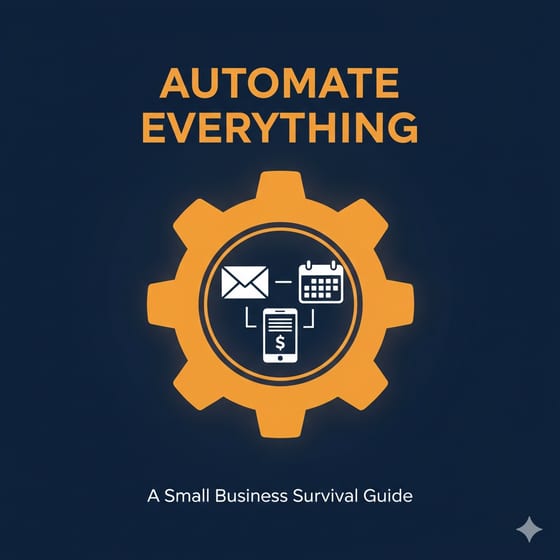
What’s Inside
Small-business admin can include invoice reminders, quote follow-ups, scheduling, record keeping, and repeated customer messages.
This book focuses on practical tools and processes that Australian small businesses can assess and introduce at a manageable pace.
Who It’s For
- Tradies running solo or with a small crew
- Consultants stuck in feast-or-famine cycles
- Small business owners mapping recurring admin processes
- Anyone assessing where software connections and approval steps belong
What You’ll Learn
Part 1 — The Mindset: Where your time actually goes (not where you think it goes), the automation stack explained in plain English, and how to audit your time leaks.
Part 2 — The Tools: ServiceM8, Xero, Tradify, Zapier, Make, n8n — practical overviews and selection considerations for Australian businesses. Plus communication automation, financial automation, and AI assistants that aren’t just chatbots.
Part 3 — Getting It Done: The weekend automation sprint. What to automate first, what NOT to automate, and how to maintain your systems once they’re running.
Start With a Process You Can Observe
Look for a repetitive process with a clear trigger, owner, and finish point. Map the manual steps, decide which decisions still need a person, and review the workflow in a controlled setting before relying on it. Document the systems, data fields, exceptions, and stop conditions.
37,000 words. 17 chapters. A practical way to get started.
Frequently Asked Questions
What can I automate in my small business in Australia?
Common candidates include invoicing and payment reminders, appointment scheduling, customer follow-ups, social media scheduling, and bookkeeping reconciliation. The right starting point depends on the business and its existing process.
What are the best automation tools for Australian small businesses?
The book discusses Xero for accounting, ServiceM8 and Tradify for job management, Zapier and Make for workflow automation, and ChatGPT and Claude as AI assistants. Readers should check current pricing, integrations, support, and Australian tax requirements before choosing a tool.
How much does business automation cost for a small business?
Costs depend on the tools, plan limits, number of users, and integrations required. Define the process, check current vendor pricing, and include configuration, review, and maintenance in the comparison.
Is AI actually useful for small businesses or just hype?
AI can assist with bounded tasks such as drafting emails, preparing quote descriptions, and drafting answers to common questions. It needs human review and is a poor fit for decisions requiring judgment, verified current pricing, or professional advice.
Can I automate my business without technical skills?
Many tools covered use app-based or visual interfaces. The book explains the setup in plain language, but readers still need to configure, check, and review each workflow.
5 Process Questions to Ask Before Automation
- What starts the process? — Record the event or status that acts as the trigger
- Which system is authoritative? — Identify where availability, customer, invoice, or job data is maintained
- Which steps are rules-based? — Separate fixed actions from decisions that require judgment
- What are the exceptions? — Define disputes, missing data, failed messages, and manual handoffs
- Who reviews the workflow? — Assign responsibility for access, logs, templates, and changes